Coffee from India. I have had a few interesting examples over the years, but of course nothing beats the puerile pleasure of saying "Mysore Nuggets Extra Bold". Come on - say it a few times - you know you are laughing.
Anyway, today is not about that coffee, but about an unusual coffee from India that is actually dried on the tree. The coffee cherries are left to ripen on the tree and essentially turn into little raisins. If this works well, you should get some interesting character to the coffee. If it doesn't, well....
As an aside, dry-processed coffees like this one are always going to be more variable since wet processed coffees allow you to sort out unripe cherry more easily (they float), instead of having to do things by hand. I can't imagine how much work went into this coffee, and for something which ultimately sold for a few dollars a pound.
I have roasted this coffee a few times, so the notes are a compilation over those sessions. This is a somewhat low-altitude coffee, so it is easy for the roast to get away from you if you heat it up too fast. Slow and gentle wins the race. The coffee was roasted to a Full City level.
This coffee has some very nice dry-roasted peanut notes, low acidity, but coupled with an interesting fruitiness. In the aroma, I swear I smell ripe melon. Interesting! I am not sure I have tasted anything quite like it. It is sort or a cross between something like a low-acid Sumatra coffee mixed with the fruitiness of an Ethiopian. The combination is somewhat unexpected, but very pleasant nonetheless.
Thursday, June 12, 2008

Monday, June 9, 2008
Kenya Thika - Gethumbwini Peaberry
This is the last of my beans from the 2007 main crop. I thought this coffee was one of the best of 2007. My notes from last October read, "Intense stuff. In-your-face sweet grape and blackberry aroma. Powerful, crisp, sweet, and acidy. Medium body. A powerhouse of a coffee that keeps getting better and better every day I drink it". Hardly faint praise.
Since the new crop had come in, I wanted to finish off all of the last stuff I had laying around, so I roasted it up the other day. The profile was slightly different than the first time:
This was a faster roast then back in October, and I think the body suffered a bit. However, the intense fruit character that I love is still there. Think ripe cherries, blackberries, grapes overlaid with fresh sage and other herbs. It is definitely a unique taste profile for coffee, and quite unexpected. Personally I love the stuff, but I could see people who favor a more "classic" coffee taste might be put off.
________________________________________________
Addendum 6/11/08
As is often the case, this coffee gets better with more rest. Besides the great fruitiness, I get a strong sense of Ricola candies in the aroma. Interesting! The herbal qualities of this coffee are something I hadn't fully appreciated before with previous roasts.
Since the new crop had come in, I wanted to finish off all of the last stuff I had laying around, so I roasted it up the other day. The profile was slightly different than the first time:
This was a faster roast then back in October, and I think the body suffered a bit. However, the intense fruit character that I love is still there. Think ripe cherries, blackberries, grapes overlaid with fresh sage and other herbs. It is definitely a unique taste profile for coffee, and quite unexpected. Personally I love the stuff, but I could see people who favor a more "classic" coffee taste might be put off.
________________________________________________
Addendum 6/11/08
As is often the case, this coffee gets better with more rest. Besides the great fruitiness, I get a strong sense of Ricola candies in the aroma. Interesting! The herbal qualities of this coffee are something I hadn't fully appreciated before with previous roasts.
Friday, June 6, 2008
Yemen Mokha Mattari Redux
Bear with me here - I am highly caffeinated at the moment. I consumed a lot of espresso this morning to write this piece. Such are the sacrifices we make....
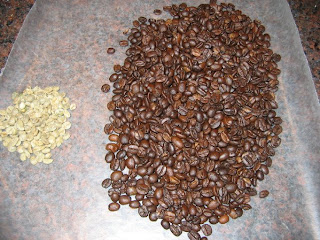
I described last month a roast of Yemen Mokha Mattari from Sweet Marias. Despite some mishaps during roasting, it turned out particularly well as brewed coffee. Last Friday I decided to roast up some more of these beans, but take them darker for use as espresso. The claim is that Yemen's like a lot of rest to really come together flavor-wise, so this is a good test. I also added the picture above to show the "before and after" of the coffee.
Here is the profile:
As you can see, another minute and a half of roast compared to the previous gets you into second crack. This is what I was looking for in this roast. The espresso extraction process can really exacerbate acidic flavors, and light roasts in general don't do well. I roasted this one dark (for me) to get better balance.
As an interesting aside, you can take a look at the variation in color post-roast (common in dry-processed beans) in this picture:
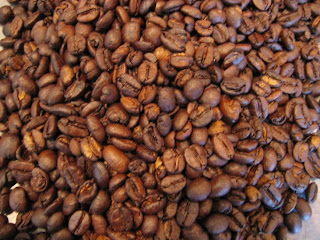
If you compare this to something like the picture in the blog's title (which is a Guatemalan coffee), you should see the differerce.
So, what about the espresso? I tried this coffee three ways (shots pulled from my Rancilio Silvia machine):
Double espresso
Cappucino (double shot in ~6oz of milk)
Double ristretto
Now you are starting to understand the caffeine jag I am on....
Anyway, this stuff was darn good. The espresso was very intensely woody, with a packed house of "spice bazaar" tastes. Chewy and very long lasting. Great stuff, but a bit on the rough side. In milk, it really shined. The spice notes were still there, and solid chocolate notes cut well through the milk. The ristretto was probably the best of the bunch. A lot of the roughness was gone, and it was smooth, sweet, spicy, and exotic. I didn't get any real fruitiness in this one; it was more in the woody camp. Perhaps another roast treatment would pull out more fruit.

I described last month a roast of Yemen Mokha Mattari from Sweet Marias. Despite some mishaps during roasting, it turned out particularly well as brewed coffee. Last Friday I decided to roast up some more of these beans, but take them darker for use as espresso. The claim is that Yemen's like a lot of rest to really come together flavor-wise, so this is a good test. I also added the picture above to show the "before and after" of the coffee.
Here is the profile:
As you can see, another minute and a half of roast compared to the previous gets you into second crack. This is what I was looking for in this roast. The espresso extraction process can really exacerbate acidic flavors, and light roasts in general don't do well. I roasted this one dark (for me) to get better balance.
As an interesting aside, you can take a look at the variation in color post-roast (common in dry-processed beans) in this picture:

If you compare this to something like the picture in the blog's title (which is a Guatemalan coffee), you should see the differerce.
So, what about the espresso? I tried this coffee three ways (shots pulled from my Rancilio Silvia machine):
Double espresso
Cappucino (double shot in ~6oz of milk)
Double ristretto
Now you are starting to understand the caffeine jag I am on....
Anyway, this stuff was darn good. The espresso was very intensely woody, with a packed house of "spice bazaar" tastes. Chewy and very long lasting. Great stuff, but a bit on the rough side. In milk, it really shined. The spice notes were still there, and solid chocolate notes cut well through the milk. The ristretto was probably the best of the bunch. A lot of the roughness was gone, and it was smooth, sweet, spicy, and exotic. I didn't get any real fruitiness in this one; it was more in the woody camp. Perhaps another roast treatment would pull out more fruit.
Wednesday, June 4, 2008
Kenya AA Giakanja Coop Coffee Mill
It look me some time to get to like Kenya coffees. The altitude and climate these coffees are grown at can produce some ferocious acidity in coffee. Some people like this, and some people don't. Originally, I didn't.
The issue is the difference between acidity and sourness. When the term "acidity" is used when referring to coffee, it is the slight puckering sensation and crispness to the cup that actually makes the coffee very refreshing and drinkable. However, when not done correctly (or under-roasted), this can turn into a grassy, sour flavor that can make your whole body shudder. Back in the day I roasted a lot of coffee that tasted like that and it really turned me off.
Now that I am pretty devoted to light roasted coffee. I find that when done correctly, the brightness of Kenya coffees comes with a sweetness and complexity that you will find in few other places. Now I can't get enough of the stuff.
This particular coffee was roasted quite lightly the first time around, back in March of this year:
My notes were as follows:
3/23/08: "Intense stuff. Very powerful flowery aroma - roses! Interesting bitterness to go with it. Perhaps could have ended the roast a tad sooner"
3/24/08: "This aroma is so weird - I have never smelled anything like it in a coffee. In your face rose bush aroma. Unique, but I don't care for it"
I tell you, I have had weird fruity aromas, intense florals, nuts, you name it. But this rose aroma was so strong it turned my stomach.
With a half pound left, I decided to pawn this coffee off on my co-workers. I decided to roast it much darker to see if I could drive off the weird aroma. The profile this time is as follows (yellow marks the differences from the previous):
This time the coffee was roasted into second crack. With this treatment, the odd rose aroma was gone, and I was left with a very nice, pungent, and rustic cup. Not a coffee I would rush to buy again, but certainly very drinkable. It never ceases to amaze me how the same coffee roasted different ways can be so different in the cup.
The issue is the difference between acidity and sourness. When the term "acidity" is used when referring to coffee, it is the slight puckering sensation and crispness to the cup that actually makes the coffee very refreshing and drinkable. However, when not done correctly (or under-roasted), this can turn into a grassy, sour flavor that can make your whole body shudder. Back in the day I roasted a lot of coffee that tasted like that and it really turned me off.
Now that I am pretty devoted to light roasted coffee. I find that when done correctly, the brightness of Kenya coffees comes with a sweetness and complexity that you will find in few other places. Now I can't get enough of the stuff.
This particular coffee was roasted quite lightly the first time around, back in March of this year:
My notes were as follows:
3/23/08: "Intense stuff. Very powerful flowery aroma - roses! Interesting bitterness to go with it. Perhaps could have ended the roast a tad sooner"
3/24/08: "This aroma is so weird - I have never smelled anything like it in a coffee. In your face rose bush aroma. Unique, but I don't care for it"
I tell you, I have had weird fruity aromas, intense florals, nuts, you name it. But this rose aroma was so strong it turned my stomach.
With a half pound left, I decided to pawn this coffee off on my co-workers. I decided to roast it much darker to see if I could drive off the weird aroma. The profile this time is as follows (yellow marks the differences from the previous):
This time the coffee was roasted into second crack. With this treatment, the odd rose aroma was gone, and I was left with a very nice, pungent, and rustic cup. Not a coffee I would rush to buy again, but certainly very drinkable. It never ceases to amaze me how the same coffee roasted different ways can be so different in the cup.
Tuesday, June 3, 2008
Roasting Apparatus
I just realized that I haven't mentioned what I am roasting with. All these roast profiles aren't that useful unless you have some idea what I am doing.
Anyhoo, I originally started out roasting using an iRoast2. This is a decent starter machine, but I had some quality issues with it (the power base kept dying), and the amount of beans you can roast at one time is rather limited. Still, the coffee was decent, and had the typical air-roaster quality of "brightness" in the cup.
At this point, a hoard of people are going to come out of the woodwork (or maybe not, since not too many people read these entries...) and tell me that you can produce great roasted coffee with a wok, a roasting pan, a heat gun and a dog bowl, a popcorn popper, a blowtorch, or perhaps a small thermonuclear explosion. In a sense they are correct, and you can read for hours and hours on the web about these things.
However, roasting coffee is more than "turning beans brown". The profiles of time and temperature make a huge difference to the final product. Even two roasts with exactly the same final roast time, with different ways of getting there can be completely different. It is useful to have some control over time and temperature (and ramp rate if you can get it). This can be done manually with some effort, but there are some machines out there that make it much simpler. I am a gadget guy, so I went the route of buying a GeneCafe.
I won't review the machine here; you can read about it in the link above, or search around on Coffee Geek or other web sites. Suffice to say that you have very good control over the key variables.
My typical batch size is 8oz. The way I drink coffee at home, that gets me through about a week. For espresso, I'll often drop it down to 6oz or so, since I drink less espresso than drip coffee. I also like to preheat the machine a bit before adding the beans. There is a lot of glass and metal that should get hot first, such that the thermal energy goes into the coffee beans instead of heating up the machine. Pre-heating can also have a pronounced effect on the ability to hear first crack, which I can talk about another time.
For cooling, I typically use the "Emergency stop" procedure which cools the coffee in the drum down to about 212 degrees. Then I move the coffee to a sheet pan on my granite countertop, which quickly cools things to room temperature. I then let the machine complete the rest of its cooling cycle down to 140 degrees, which hopefully will help out the lifetime of the roaster.
There are other options out there as well, ranging from the now very popular Behmor roaster, the Hottop, and others. However, my GeneCafe is going strong, and makes great coffee.
As for brewing the coffee, I have an article I need to parse through before posting here, but there is a lot to say on that topic as well.
Anyhoo, I originally started out roasting using an iRoast2. This is a decent starter machine, but I had some quality issues with it (the power base kept dying), and the amount of beans you can roast at one time is rather limited. Still, the coffee was decent, and had the typical air-roaster quality of "brightness" in the cup.
At this point, a hoard of people are going to come out of the woodwork (or maybe not, since not too many people read these entries...) and tell me that you can produce great roasted coffee with a wok, a roasting pan, a heat gun and a dog bowl, a popcorn popper, a blowtorch, or perhaps a small thermonuclear explosion. In a sense they are correct, and you can read for hours and hours on the web about these things.
However, roasting coffee is more than "turning beans brown". The profiles of time and temperature make a huge difference to the final product. Even two roasts with exactly the same final roast time, with different ways of getting there can be completely different. It is useful to have some control over time and temperature (and ramp rate if you can get it). This can be done manually with some effort, but there are some machines out there that make it much simpler. I am a gadget guy, so I went the route of buying a GeneCafe.
I won't review the machine here; you can read about it in the link above, or search around on Coffee Geek or other web sites. Suffice to say that you have very good control over the key variables.
My typical batch size is 8oz. The way I drink coffee at home, that gets me through about a week. For espresso, I'll often drop it down to 6oz or so, since I drink less espresso than drip coffee. I also like to preheat the machine a bit before adding the beans. There is a lot of glass and metal that should get hot first, such that the thermal energy goes into the coffee beans instead of heating up the machine. Pre-heating can also have a pronounced effect on the ability to hear first crack, which I can talk about another time.
For cooling, I typically use the "Emergency stop" procedure which cools the coffee in the drum down to about 212 degrees. Then I move the coffee to a sheet pan on my granite countertop, which quickly cools things to room temperature. I then let the machine complete the rest of its cooling cycle down to 140 degrees, which hopefully will help out the lifetime of the roaster.
There are other options out there as well, ranging from the now very popular Behmor roaster, the Hottop, and others. However, my GeneCafe is going strong, and makes great coffee.
As for brewing the coffee, I have an article I need to parse through before posting here, but there is a lot to say on that topic as well.
In Defense of Light Roasting
How many times have you heard something like "I love French Roast coffee". Or, "I like coffee that 'bites back' ". Well, you might as well say "I love some tasteless charcoal drowned in milk and sugar". Sadly, what passes for coffee in many establishments is horribly over-roasted and well past its prime. Also, there seems to be some macho thing going on, with the strongest and darkest possible coffee correlating to testosterone levels or something similar.
As an aside, in a Starbucks last week (I was there for a Green Tea Frappucino - yum - not coffee), I saw a sign advertising their new "Pike Place Blend". They proudly wrote on the blackboard, "Roasted in our York, PA roasting facility on April 10". April 10, my friend. That coffee is more than a month old and is more than likely truly putrid. (Actually, to put my money where my mouth is, I will plan on picking up a cup of Pike Place blend and do a review here in the near future. Should be interesting....)
Anyway, back to my point about dark roasting. Coffee, much like wine, has thousands of aroma/flavor compounds, and a very unique sense of terroir - the essence of the area the coffee is grown in; soil, weather, preparation, etc. However, it takes a lot of skill to bring out those notes without overwhelming them with roast character. For commercial roasters, this is exactly why very dark roasted coffee is the norm. It is easy to gain consistency of product when all you are tasting is carbon. Sure, a venti half-caf vanilla macchiato with soy milk tastes the same from Timbuktu to Tijuana, but it sure doesn't taste anything like good coffee.
On the flip side, very lightly roasted coffee, if not roasted carefully can be as sour as lemons and as nasty as chewing on lawn clippings. Think truck-stop coffee or some of the stuff that is served in work cafeterias. The roaster has to carefully allow the coffee to develop during the roasting process without imparting too much energy such that things go either too quickly or too dark, both of which are bad.
In other words, light roasting coffee takes skill, but you are rewarded with much more complexity in the cup. You can more easily appreciate the tropical fruit notes in an Ethiopian dry-processed coffee, for example, or the soaring acidity of a Kenya. Roast them dark and a lot of those delicate notes are gone, replaced by roast flavors. You'll notice that a lot of the stuff I roast is roasted without ever approaching second crack. It can be a pain to get it right, but when you nail the roast, you truly get something special that links you fundamentally to the area where the coffee was grown.
There are a few commercial roasters out there who get it right. One of the first I tried before getting into homeroasting was the excellent coffee from Din Johnson at Ristretto Roasters. There are others out there as well which can be very good (Intelligentsia, Stumptown, Paradise, etc.), but of course roasting your own provides a different level of satisfaction.
Oh, and one more thing. Roasting for espresso is a different proposition. I think most places still way over-roast their blends for espresso, but in general you need to go a bit darker for use in espresso due to the way the extraction process can blow certain flavor characteristics out of proportion.
So there you have it. Try expanding your horizons and enjoy some lightly roasted coffee. Do me a favor and leave out the milk and sugar as well.
As an aside, in a Starbucks last week (I was there for a Green Tea Frappucino - yum - not coffee), I saw a sign advertising their new "Pike Place Blend". They proudly wrote on the blackboard, "Roasted in our York, PA roasting facility on April 10". April 10, my friend. That coffee is more than a month old and is more than likely truly putrid. (Actually, to put my money where my mouth is, I will plan on picking up a cup of Pike Place blend and do a review here in the near future. Should be interesting....)
Anyway, back to my point about dark roasting. Coffee, much like wine, has thousands of aroma/flavor compounds, and a very unique sense of terroir - the essence of the area the coffee is grown in; soil, weather, preparation, etc. However, it takes a lot of skill to bring out those notes without overwhelming them with roast character. For commercial roasters, this is exactly why very dark roasted coffee is the norm. It is easy to gain consistency of product when all you are tasting is carbon. Sure, a venti half-caf vanilla macchiato with soy milk tastes the same from Timbuktu to Tijuana, but it sure doesn't taste anything like good coffee.
On the flip side, very lightly roasted coffee, if not roasted carefully can be as sour as lemons and as nasty as chewing on lawn clippings. Think truck-stop coffee or some of the stuff that is served in work cafeterias. The roaster has to carefully allow the coffee to develop during the roasting process without imparting too much energy such that things go either too quickly or too dark, both of which are bad.
In other words, light roasting coffee takes skill, but you are rewarded with much more complexity in the cup. You can more easily appreciate the tropical fruit notes in an Ethiopian dry-processed coffee, for example, or the soaring acidity of a Kenya. Roast them dark and a lot of those delicate notes are gone, replaced by roast flavors. You'll notice that a lot of the stuff I roast is roasted without ever approaching second crack. It can be a pain to get it right, but when you nail the roast, you truly get something special that links you fundamentally to the area where the coffee was grown.
There are a few commercial roasters out there who get it right. One of the first I tried before getting into homeroasting was the excellent coffee from Din Johnson at Ristretto Roasters. There are others out there as well which can be very good (Intelligentsia, Stumptown, Paradise, etc.), but of course roasting your own provides a different level of satisfaction.
Oh, and one more thing. Roasting for espresso is a different proposition. I think most places still way over-roast their blends for espresso, but in general you need to go a bit darker for use in espresso due to the way the extraction process can blow certain flavor characteristics out of proportion.
So there you have it. Try expanding your horizons and enjoy some lightly roasted coffee. Do me a favor and leave out the milk and sugar as well.
Monday, June 2, 2008
Guatemala Antigua Finca Retana Yellow Bourbon (and an experiment)
There is much to say about this coffee, and the roast. First of all, for all you alcoholics out there, "bourbon" is the particular coffee cultivar that is grown on this estate. It traces back to the island of Reunion (also known as Bourbon at various parts of its history), and is pronounced "bore-BONE". For an interesting discussion of the geography and history of this place, you can check out this Wikipedia article. See? A history lesson together with your coffee.
Getting progressively more interesting, there is the color of the coffee cherry. Most of the coffee grown around the world has red fruit, such as:
 You won't be surprised that Yellow Bourbon coffee has..... you guessed it - yellow fruit!

Anyway, on to the roasting. I admit that I am not normally a huge fan of the bourbon variety of coffee (reasons for that another time), but I was intrigued by this particular lot and the usual flowery descriptions of ripe, juicy fruit, peaches, etc.
I roasted half of this lot back on April 4, and the rest of it last Friday. Here is Friday's roast profile:
Comparing this roast to the one I did in April, you will see that this one had a higher initial temperature - 350 degrees versus 300 degrees:
First roast was shorter, both first crack and final roast time were faster. In general with these profiles, I try to "sneak up" on first crack when I am targeting a light roast, such that there is ample time for flavor development.
Let's compare my tasting notes from the two roasts:
4/4/08: "Sweet white grape juice & fruit in aroma. Taste is classic bourbon varietal. Acidy but not sour."
6/2/08: "GREAT. Better than last roast, despite being a shorter roast. Fruity notes are more muted, but sweetness and acidity are merged beautifully. Very juicy coffee"
This coffee is for people who like bright and sweet brews. Intense stuff that of course you will drink black (is there another way?).
This experiment also highlights how important the temperature is during the first part of the roast. Early in my roasting career, I had fairly low temperatures there just to get moisture out of the bean. Now I know that if you want to avoid grassy notes and overpowering acidity, it is better to have the temperature a bit higher. Depending on what I am trying to get out of the coffee, I will play around with this.
Oh, one other note about this coffee. It roasts up just beautifully. The bourbon stock, along with the serious altitude this coffee is grown at, makes for some incredibly dense seeds. The prep is beautiful as well. Take a look at how even the roast is:
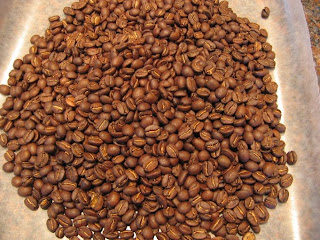
For an upcoming post, I took some pictures of some Yemen coffee, and you'll see the difference in roast evenness.
_______________________________________________
Addendum 6/4/08
I brought this coffee into work today, and was even happier with it. I got the strong white grape juice aromas this time, and boy was this stuff smooth. Great coffee, and sure would be a crowd pleaser.
Getting progressively more interesting, there is the color of the coffee cherry. Most of the coffee grown around the world has red fruit, such as:
 You won't be surprised that Yellow Bourbon coffee has..... you guessed it - yellow fruit!
Anyway, on to the roasting. I admit that I am not normally a huge fan of the bourbon variety of coffee (reasons for that another time), but I was intrigued by this particular lot and the usual flowery descriptions of ripe, juicy fruit, peaches, etc.
I roasted half of this lot back on April 4, and the rest of it last Friday. Here is Friday's roast profile:
Comparing this roast to the one I did in April, you will see that this one had a higher initial temperature - 350 degrees versus 300 degrees:
First roast was shorter, both first crack and final roast time were faster. In general with these profiles, I try to "sneak up" on first crack when I am targeting a light roast, such that there is ample time for flavor development.
Let's compare my tasting notes from the two roasts:
4/4/08: "Sweet white grape juice & fruit in aroma. Taste is classic bourbon varietal. Acidy but not sour."
6/2/08: "GREAT. Better than last roast, despite being a shorter roast. Fruity notes are more muted, but sweetness and acidity are merged beautifully. Very juicy coffee"
This coffee is for people who like bright and sweet brews. Intense stuff that of course you will drink black (is there another way?).
This experiment also highlights how important the temperature is during the first part of the roast. Early in my roasting career, I had fairly low temperatures there just to get moisture out of the bean. Now I know that if you want to avoid grassy notes and overpowering acidity, it is better to have the temperature a bit higher. Depending on what I am trying to get out of the coffee, I will play around with this.
Oh, one other note about this coffee. It roasts up just beautifully. The bourbon stock, along with the serious altitude this coffee is grown at, makes for some incredibly dense seeds. The prep is beautiful as well. Take a look at how even the roast is:

(Click to Enlarge)
For an upcoming post, I took some pictures of some Yemen coffee, and you'll see the difference in roast evenness.
_______________________________________________
Addendum 6/4/08
I brought this coffee into work today, and was even happier with it. I got the strong white grape juice aromas this time, and boy was this stuff smooth. Great coffee, and sure would be a crowd pleaser.
Subscribe to:
Posts (Atom)