Thursday, October 22, 2009

Ethiopia Dry-Process Birbissa

As I think I have mentioned, there is very little information on "optimum roast profiles" out there. Searching the internet will find tidbits, but it is still a DYI affair for the most part. If I had to sum up the conventional wisdom such as it is, it would be this:

  • Keep roast times below 14 minutes or so
  • Slow start/fast finish is better than the reverse
  • There are three main segments of the roast:
  1. The drying segment, from start to about 300 degrees, should be about 3-5 minutes (longer for light roasts and shorter for dark roasts)
  2. The segment from 300 degrees to the start of first crack should be as rapid as possible to avoid woody flavors
  3. From the onset of first crack to end of roast should be 3-5 minutes. Shorter for drip and longer for espresso

Got all that?

Let's have a look at this roast of Ethiopia Birbissa:
Ethiopia Birbissa

Under 14 minutes? Check.
5 minutes to dry? Check.
Fast ramp to first? Maybe.

Pretty good against the "standard" if I do say so myself. Too bad I totally spaced out during the roast and forgot to lower the heat when I originally wanted to, but in the end it seems to have worked out. I wished I had pulled it a bit sooner since the roast got a bit darker than I had intended, but so be it.

The aroma in the cup was amazing. Pure, pure blueberies all the way. This is really the first coffee I have had that has been so distinct in one berry note, though I jave had many others with grape, strawberry, etc. Very nice. The taste follows suit, but the acidity was lower than I wanted, either due to the coffee or the roast - I am not sure. The body was syrupy and overall this was a nice dry-process cup, but nothing that exciting, IMO.

Tuesday, October 13, 2009

Colombia Finca Buenavista -Carlos Imbachi Microlot

Boy, did I forget how hard stainless steel is to machine with home tools. Over the weekend I set out to install a thermometer probe into my Hottop, following the basic method outlined here. Sounds easy, right? Well, let's just say that much cursing ensued as I tried to drill through things with my electric drill. Anyway, its in there, giving me access to the actual bean mass temperature instead of just the Hottop's sensor which is bolted to the back wall. And a good thing, too! See:
roast profile
This was a roast of a Columbian bean that I had ruined (and never blogged about, of course) with my Gene Cafe when it was having troubles. The blue line is from the Hottop readout and the pink from my new thermoprobe. Obviously, one should pay attention to the pink line, which is a fast acting K-type thermocouple buried in the rotating beans. You'll notice the temperature drop when you add the beans which is not sensed by the stock thermocouple, and the eventual crossover of the curves.

I highlighed the times where I played with the heater power to slow things down, and I also boxed out the area where first crack started and ended from about 10:45 to 13:30. What I was attempting to do was slow down the rate of heat transfer going into first crack in order to improve flavor development and have enough time after the end of first and before the onset of second crack. You can see that I stalled things out a bit where the pink curve flattens around 11 minutes in, and eventually it ramps up again later until I dropped the beans into the cooling tray. I need to play with the heat and fan settings more to have a slow but steady temperature increase instead of this stalling behavior. This roaster is like driving a Ferrari compared with the very slow reacting Gene Cafe. Still, you clearly need to anticipate things by a minute or so given the electric heating on the Hottop. Lots of room for improvement, that's for sure.

Anyway, the coffee was a nice City+ roast and was actually a decent cup. There were very intense fruity notes both in the aroma and taste. I called it tamarind in my notes, but I see that Tom from Sweetmarias called it guava. Your choice. The acidity was nicely controlled, and the cup was quite refreshing. As it cooled, there was a bit of a flavor change that is hard to describe, but I attribute it to stalling out the roast a bit and having things drag on too long. Let's call it "flat". Most people wouldn't pick up on it, but after roasting a lot of coffee I am starting to be able to tell what went wrong.

My next few efforts will be to speed things up a tad, and keep playing with the heat settings.

Monday, October 5, 2009

A New Toy and a New Learning Curve

Hottop
Well, I ended up going down quite a rathole with my Gene Cafe. I replaced the heater, but things still weren't as they were. As far as I can tell it works ok, but something is just different than before. After roasting a pound or two a week for years, I knew what the coffee from that roaster was going to taste like and what the behavior during the roast would be. For whatever reason, something changed and I was staring down a new learning curve. The coffee just wasn't good enough.

Then the little devious part of my mind started working. "Hey Scotto, if you are going to have to learn something all over again, why not upgrade and do it on a new machine? Expensive? Sure it is. You're worth it, though...." Before I knew it, a Hottop roaster was on its way to me.

I had quite the internal debate over roasters. Everyone is hot on the Behmor roaster (pun intended), and it is certainly a lot cheaper than a Hottop. The deal breaker for me was the fact that you can't control the roast profile. Being a scientific type, I like to be able to control things and tune profiles for different coffees. That, combined with the excellent track record of build quality of the Hottop, as well as external cooling of the beans, won me over.

A few roasts in, and this is definitely a different beast for me. There is fine tuning over the heater power (not just on/off like the Gene) and a variable fan as well. The stock thermocouple is bolted to the rear wall and is slow to react, so that will have to be addressed as well. My first couple of roasts blasted through first crack into second. After that, I learned to anticipate first crack and turn down the heater to gently ease the beans into it. By the way, I can't believe how quiet this thing is and how trivial it is to hear the cracks. There is no mistaking them whatsoever, and the challenge in other roasters of hearing over air blasting or inside a closed drum is gone. What a pleasure!

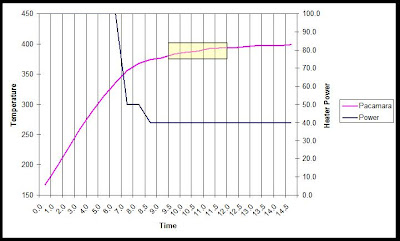
Here is a look at a recent profile:
Roast Profile

You can see that I reduced the heater power at about 7:30 in, and the slow reaction of the measured temperature. Remember that this temperature (the pink line) is the essentially the temperature of the back wall of the roaster, not the bean temperature. I boxed out where 1st crack stopped and ended as well.

Unfortunately each bean is different, and changing power and fan on the fly is difficult, so I ordered a thermocouple probe to be able to get at the temperature of the bean mass itself. Stay tuned for that. I'll also mention how nice it is to dump the beans when you want, so there is no worries about "coasting" after you reach your desired roast level. The external cooling works great.

Most importantly, the coffee has been very good. Roasts in the Hottop are extremely sweet and full bodied, especially good for espresso. I suspect as I get better and driving this thing I will exceed my previous coffee skill by a wide margin.

Tuesday, August 18, 2009

Down But Not Out

Hi folks. Sorry about the lack of updates here (though I have been adding things to my cooking blog). Usually I would blame things on work, but in this case I have been having hardware issues with my roaster.

Over the past few weeks, my usually ultra-consistent roasts have been all over the place. Some race through first crack into second with nary a "thank you, ma'am", and others struggle to achieve target temperatures. I have more or less convinced myself that I need a new heater/thermostat assembly for my Gene Cafe. One is winging itself my way as we speak, so hopefully I am back in action soon, and more importantly, I don't have to re-learn my machine. Stay tuned.

Thursday, July 23, 2009

Costa Rica "La Margarita" Honey

Use of "unconventional" processing (not wet-processed) coffee seems to have flourished in Central America over the past few years. The increased body and fruity flavors associated with leaving the fruity mucilage layer on the coffee seed longer is something that can be very attractive.

That being said, I get the sense that a lot of these coffees have forgotten their origins as really excellent coffees, letting the processing flavors take over too much. This particular coffee is special in that there is a really lively acidity that competes with the miel chewiness/waxiness.

Aromas from the roaster are often harbingers of things to come, and this is no exception. Flowers and malt, all the way. In the cup, that floral note continues, with more malt, milk chocolate, and some nuts. It is juicy and supremely drinkable, a honey coffee that hasn't forgotten its origins as a great Central.

Monday, July 13, 2009

Brazil Ipanema Tree-Dried Process

Why do I keep buying Brazilian coffees? They all taste like one-dimensional, ashy coffees to me, with the exception of my beloved, Poco Fundo. Mmm, Poco Fundo (insert Homer Simpson voice)....

Anyway, I have been doing a lot of roasting for espresso lately, and I am always on the lookout for interesting coffees to add in. This one caught my eye because of the "tree dried" moniker, and the allusion to Oreo cookies in the review at Sweet Marias. Recall that I had tried a tree-dried coffee before, and it was interesting, so I bit for a pound.

I roasted this twice. The first time was in my standard treatment:

For some reason, this coffee raced from 1st to 2nd crack and got away from me. It ended up as a Vienna roast. In a second session, I blended it (pre-roast) with some Uganda Bugisu, and that was a more normal behavior during the roast.

As espresso, this was indeed redolent of an Oreo cookie. You got that chocolate cookie thing going on, with a very unusual creaminess to the body and taste that reminds you of that cookie center, which is of course nothing more than vegetable shortening and sugar.... It is certainly an interesting effect, but I found the whole thing a bit one-dimensional. It lacked that dynamism (is that a word?) that you get from a great dry-pricessed coffee, that core of spices and leather that keeps things interesting. Even blended with the Uganda, I just didn't find it interesting. Oh, well, another Brazil bites the dust. I am done with this origin, with the one exception.

Tuesday, June 30, 2009

Kenya Kiambu Peaberry -Ndumberi Coop

There are a few things that really make you stop and appreciate life. The first blooming tulips in spring, taking a quiet evening walk, etc. To this, I will add the aroma of freshly roasted, quality Kenya coffee. A lot of people like to talk about resting coffee after roasting for a day or more, but to me this is just staling it. If you want to try something special, brew a vacuum pot of a really good Kenya coffee about 12 hours after you roast it. The aromas are so piercing, so floral, so sweet that there is almost nothing else like it.

Coffee is a seasonal crop, and I went some time without Kenyas in my stash. This coffee reminded me how much I missed it. Word on the street is that 2009 is going to be a great year for coffees from this origin, and I am looking forward to it in a big way.

After roasting a lot of coffees darker than I otherwise might have, working on the blend I previously talked about, I wanted to get a nice, crisp, light roast on this one:


The aromas of the grounds, and in the cup, are pure muesli: sweet toasted grains, brown sugar, and dried fruits. It is a heady aroma, almost intoxicating in its sweetness. The taste follows, with refreshing acidity, some green grape, and a chocolate note that gets more prevalent as the coffee ages a bit. For me Kenyas change very rapidly after roasting. Capturing that initial burst of aroma and fruit before the roast and chocolate notes take over is one of the purest pleasures of roasting your own, and something you can't get in storebought coffee. What a great cup.