How many times have you heard something like "I love French Roast coffee". Or, "I like coffee that 'bites back' ". Well, you might as well say "I love some tasteless charcoal drowned in milk and sugar". Sadly, what passes for coffee in many establishments is horribly over-roasted and well past its prime. Also, there seems to be some macho thing going on, with the strongest and darkest possible coffee correlating to testosterone levels or something similar.
As an aside, in a Starbucks last week (I was there for a Green Tea Frappucino - yum - not coffee), I saw a sign advertising their new "Pike Place Blend". They proudly wrote on the blackboard, "Roasted in our York, PA roasting facility on April 10". April 10, my friend. That coffee is more than a month old and is more than likely truly putrid. (Actually, to put my money where my mouth is, I will plan on picking up a cup of Pike Place blend and do a review here in the near future. Should be interesting....)
Anyway, back to my point about dark roasting. Coffee, much like wine, has thousands of aroma/flavor compounds, and a very unique sense of terroir - the essence of the area the coffee is grown in; soil, weather, preparation, etc. However, it takes a lot of skill to bring out those notes without overwhelming them with roast character. For commercial roasters, this is exactly why very dark roasted coffee is the norm. It is easy to gain consistency of product when all you are tasting is carbon. Sure, a venti half-caf vanilla macchiato with soy milk tastes the same from Timbuktu to Tijuana, but it sure doesn't taste anything like good coffee.
On the flip side, very lightly roasted coffee, if not roasted carefully can be as sour as lemons and as nasty as chewing on lawn clippings. Think truck-stop coffee or some of the stuff that is served in work cafeterias. The roaster has to carefully allow the coffee to develop during the roasting process without imparting too much energy such that things go either too quickly or too dark, both of which are bad.
In other words, light roasting coffee takes skill, but you are rewarded with much more complexity in the cup. You can more easily appreciate the tropical fruit notes in an Ethiopian dry-processed coffee, for example, or the soaring acidity of a Kenya. Roast them dark and a lot of those delicate notes are gone, replaced by roast flavors. You'll notice that a lot of the stuff I roast is roasted without ever approaching second crack. It can be a pain to get it right, but when you nail the roast, you truly get something special that links you fundamentally to the area where the coffee was grown.
There are a few commercial roasters out there who get it right. One of the first I tried before getting into homeroasting was the excellent coffee from Din Johnson at Ristretto Roasters. There are others out there as well which can be very good (Intelligentsia, Stumptown, Paradise, etc.), but of course roasting your own provides a different level of satisfaction.
Oh, and one more thing. Roasting for espresso is a different proposition. I think most places still way over-roast their blends for espresso, but in general you need to go a bit darker for use in espresso due to the way the extraction process can blow certain flavor characteristics out of proportion.
So there you have it. Try expanding your horizons and enjoy some lightly roasted coffee. Do me a favor and leave out the milk and sugar as well.
Tuesday, June 3, 2008

Monday, June 2, 2008
Guatemala Antigua Finca Retana Yellow Bourbon (and an experiment)
There is much to say about this coffee, and the roast. First of all, for all you alcoholics out there, "bourbon" is the particular coffee cultivar that is grown on this estate. It traces back to the island of Reunion (also known as Bourbon at various parts of its history), and is pronounced "bore-BONE". For an interesting discussion of the geography and history of this place, you can check out this Wikipedia article. See? A history lesson together with your coffee.
Getting progressively more interesting, there is the color of the coffee cherry. Most of the coffee grown around the world has red fruit, such as:
 You won't be surprised that Yellow Bourbon coffee has..... you guessed it - yellow fruit!

Anyway, on to the roasting. I admit that I am not normally a huge fan of the bourbon variety of coffee (reasons for that another time), but I was intrigued by this particular lot and the usual flowery descriptions of ripe, juicy fruit, peaches, etc.
I roasted half of this lot back on April 4, and the rest of it last Friday. Here is Friday's roast profile:
Comparing this roast to the one I did in April, you will see that this one had a higher initial temperature - 350 degrees versus 300 degrees:
First roast was shorter, both first crack and final roast time were faster. In general with these profiles, I try to "sneak up" on first crack when I am targeting a light roast, such that there is ample time for flavor development.
Let's compare my tasting notes from the two roasts:
4/4/08: "Sweet white grape juice & fruit in aroma. Taste is classic bourbon varietal. Acidy but not sour."
6/2/08: "GREAT. Better than last roast, despite being a shorter roast. Fruity notes are more muted, but sweetness and acidity are merged beautifully. Very juicy coffee"
This coffee is for people who like bright and sweet brews. Intense stuff that of course you will drink black (is there another way?).
This experiment also highlights how important the temperature is during the first part of the roast. Early in my roasting career, I had fairly low temperatures there just to get moisture out of the bean. Now I know that if you want to avoid grassy notes and overpowering acidity, it is better to have the temperature a bit higher. Depending on what I am trying to get out of the coffee, I will play around with this.
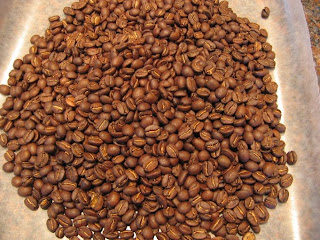
Oh, one other note about this coffee. It roasts up just beautifully. The bourbon stock, along with the serious altitude this coffee is grown at, makes for some incredibly dense seeds. The prep is beautiful as well. Take a look at how even the roast is:
For an upcoming post, I took some pictures of some Yemen coffee, and you'll see the difference in roast evenness.
_______________________________________________
Addendum 6/4/08
I brought this coffee into work today, and was even happier with it. I got the strong white grape juice aromas this time, and boy was this stuff smooth. Great coffee, and sure would be a crowd pleaser.
Getting progressively more interesting, there is the color of the coffee cherry. Most of the coffee grown around the world has red fruit, such as:
 You won't be surprised that Yellow Bourbon coffee has..... you guessed it - yellow fruit!
Anyway, on to the roasting. I admit that I am not normally a huge fan of the bourbon variety of coffee (reasons for that another time), but I was intrigued by this particular lot and the usual flowery descriptions of ripe, juicy fruit, peaches, etc.
I roasted half of this lot back on April 4, and the rest of it last Friday. Here is Friday's roast profile:
Comparing this roast to the one I did in April, you will see that this one had a higher initial temperature - 350 degrees versus 300 degrees:
First roast was shorter, both first crack and final roast time were faster. In general with these profiles, I try to "sneak up" on first crack when I am targeting a light roast, such that there is ample time for flavor development.
Let's compare my tasting notes from the two roasts:
4/4/08: "Sweet white grape juice & fruit in aroma. Taste is classic bourbon varietal. Acidy but not sour."
6/2/08: "GREAT. Better than last roast, despite being a shorter roast. Fruity notes are more muted, but sweetness and acidity are merged beautifully. Very juicy coffee"
This coffee is for people who like bright and sweet brews. Intense stuff that of course you will drink black (is there another way?).
This experiment also highlights how important the temperature is during the first part of the roast. Early in my roasting career, I had fairly low temperatures there just to get moisture out of the bean. Now I know that if you want to avoid grassy notes and overpowering acidity, it is better to have the temperature a bit higher. Depending on what I am trying to get out of the coffee, I will play around with this.
Oh, one other note about this coffee. It roasts up just beautifully. The bourbon stock, along with the serious altitude this coffee is grown at, makes for some incredibly dense seeds. The prep is beautiful as well. Take a look at how even the roast is:

(Click to Enlarge)
For an upcoming post, I took some pictures of some Yemen coffee, and you'll see the difference in roast evenness.
_______________________________________________
Addendum 6/4/08
I brought this coffee into work today, and was even happier with it. I got the strong white grape juice aromas this time, and boy was this stuff smooth. Great coffee, and sure would be a crowd pleaser.
Saturday, May 31, 2008
Mexico Organic Dry-Processed Nayarit Rustico
This coffee's appellation is a mouthful, isn't it? It is an unusual beast - a dry processed coffee from Mexico. This is something I haven't tried. By the way - I love Mexican coffees. The simple, straightforward tastes of something from Oaxaca or Chiapas are often the antidote to the crazy flavors I tend to favor from Ethiopia and elsewhere. In this case, however, the coffee is a bit crazy itself. Dry-processed coffees are processed sort of like making raisins - the whole coffee cherry is dried in the sun with the fruit and skin intact. After that, the outer layers are milled off the dry seeds. This processing can make for some interesting fruity flavors in coffee.
I decided to roast this coffee to Full City, or just a few snaps into second crack. Since it is a low-altitude coffee, I kept the temperatures moderate. The coffee was very uneven looking at the end, which isn't surprising. This morning I had a vacuum brew of it and was very pleased. Very often when these fruity coffees are roasted on the darker side, a lot of the fruit character is muted and replaced by roast notes. Not here. There was deep, rustic chocolate as a base (reminded me of....surprise... Mexican chocolate with almonds), and there was still a lot of nice tropical fruits lingering. Perhaps right on the edge of a ferment defect, but still pleasurable. This is a rich, complex, delicious coffee. Yum.
__________________________________________________________
Addendum 6/1/08
I tried this as espresso this morning. Awesome stuff. The fruit and chocolate really work well together, and there was just enough acidity to balance things out. Keep this one in mind for future espresso related endeavors.
I decided to roast this coffee to Full City, or just a few snaps into second crack. Since it is a low-altitude coffee, I kept the temperatures moderate. The coffee was very uneven looking at the end, which isn't surprising. This morning I had a vacuum brew of it and was very pleased. Very often when these fruity coffees are roasted on the darker side, a lot of the fruit character is muted and replaced by roast notes. Not here. There was deep, rustic chocolate as a base (reminded me of....surprise... Mexican chocolate with almonds), and there was still a lot of nice tropical fruits lingering. Perhaps right on the edge of a ferment defect, but still pleasurable. This is a rich, complex, delicious coffee. Yum.
__________________________________________________________
Addendum 6/1/08
I tried this as espresso this morning. Awesome stuff. The fruit and chocolate really work well together, and there was just enough acidity to balance things out. Keep this one in mind for future espresso related endeavors.
Friday, May 30, 2008
The Stash
I seem to have accumulated a lot of coffee over the past few years. Interestingly, I am more or less the only coffee drinker in the house. My wife will drink half a cup (literally) in the morning sometimes, and she likes her cappucinos, but for the most part it is just me.
So, why on earth do I have more than 40 pounds of green coffee in my house? My shelves are groaning under their weight. I can justify it in a number of ways:

1. I am saving on shipping by buying in bulk
2. I like variety
3. I am a mental case.
More than likely, #3 is the driving force, but so be it. From what I can tell from perusing other coffee sites, other people have it worse. Actually, over time, I have whittled the stash down quite a bit.
It is interesting to look at what origins make up this stash. A pie chart tells the tale, as above. I found it a bit surprising, though, since I am such a fan of African coffees. The majority is actually from Central and South America. Go figure.
Being the analytical type, I also keep a spreadsheet of what I have around, and what I think of it. Google Docs is a bit flaky, but I converted the current version to html here. Take a look. You'll have to play around a bit and convert my ratings to your sensibilities, but perhaps someone can get something useful out of it.
So, why on earth do I have more than 40 pounds of green coffee in my house? My shelves are groaning under their weight. I can justify it in a number of ways:

1. I am saving on shipping by buying in bulk
2. I like variety
3. I am a mental case.
More than likely, #3 is the driving force, but so be it. From what I can tell from perusing other coffee sites, other people have it worse. Actually, over time, I have whittled the stash down quite a bit.
It is interesting to look at what origins make up this stash. A pie chart tells the tale, as above. I found it a bit surprising, though, since I am such a fan of African coffees. The majority is actually from Central and South America. Go figure.
Being the analytical type, I also keep a spreadsheet of what I have around, and what I think of it. Google Docs is a bit flaky, but I converted the current version to html here. Take a look. You'll have to play around a bit and convert my ratings to your sensibilities, but perhaps someone can get something useful out of it.
Wednesday, May 28, 2008
Kona Kowali Estate
Believe it or not, I have never roasted a Kona coffee. Sure, I have had it here and there at coffee establishments, both in its blended form (people capitalizing on the Kona name while using ridiculously small percentages of the actual beans), as well as single-origin brews from reputable roasters. My reaction has always been, more or less "I don't get it". This stuff is seriously expensive, and my reaction to the cup is always humdrum.
I couldn't resist trying to roast some myself, though, so I sprung the $17 or so for a pound of greens. This is almost 3X the typical price I would pay for high quality coffee from other origins. The beans themselves are gorgeous - jade green and of massive size. Seriously, these are some really big beans. I suppose this has something to do with the altitude they are grown at.
The roast profile was intended to be gentle with these beans, given both their density and their price. The last thing I wanted was to carbonize these pricey beans. I targeted a City+ roast based on some other reviews of this coffee, though I understand Kona often gets a darker roast than this.
And the result? I was surprised by how much acidity was in the cup. It was somewhat unexpected, but not unpleasant. The coffee has an interesting chocolate-malt character, and is extremely intense, even at this relatively light roast. Has a good.....er.... coffee taste. Is it worth the price? Nope. It is a nice cup, but it doesn't have any unexpected character or other unusual traits that might justify the price. Compare this to something like the Gesha coffees of Panama, which are truly unique (and even then don't justify their price, IMO), and I just don't get it. I certainly enjoyed the cup, but I have little desire to buy more. Based on drinking it throughout the week, I think it would do better at a Full City roast, so I will try that at some point.
I couldn't resist trying to roast some myself, though, so I sprung the $17 or so for a pound of greens. This is almost 3X the typical price I would pay for high quality coffee from other origins. The beans themselves are gorgeous - jade green and of massive size. Seriously, these are some really big beans. I suppose this has something to do with the altitude they are grown at.
The roast profile was intended to be gentle with these beans, given both their density and their price. The last thing I wanted was to carbonize these pricey beans. I targeted a City+ roast based on some other reviews of this coffee, though I understand Kona often gets a darker roast than this.
And the result? I was surprised by how much acidity was in the cup. It was somewhat unexpected, but not unpleasant. The coffee has an interesting chocolate-malt character, and is extremely intense, even at this relatively light roast. Has a good.....er.... coffee taste. Is it worth the price? Nope. It is a nice cup, but it doesn't have any unexpected character or other unusual traits that might justify the price. Compare this to something like the Gesha coffees of Panama, which are truly unique (and even then don't justify their price, IMO), and I just don't get it. I certainly enjoyed the cup, but I have little desire to buy more. Based on drinking it throughout the week, I think it would do better at a Full City roast, so I will try that at some point.
Thursday, May 22, 2008
Why?
Perhaps it is worth a minute to discuss why I am even writing these things down. There is a practical side and an emotional side. As a practical matter, I have many notebooks full of roasting notes. It is incredibly cumbersome to go back and look for something, so I started looking for an electronic method to accomplish this. Furthermore, the coffee home roasting community may, in some small part, benefit from these notes, or at the least be amused. Since I am a bit of a tea aficionado as well, my intent is to mix some tea related notes in here as well. Finally, depending on my mood, I may have other miscellaneous musings to put down. That is the practical part. I must admit that this may be secondary to the emotional part. You see, I have an incredibly stressful life. From a job perspective, things are absolutely insane. At home, life is very busy with small children around. Combine that with a bit of a "life crisis" (note no "mid-" prefix), and I sat down to think about what I need to do. I am one of those people who express themselves best through the written word. I decided that I need to focus on a few things that I actually like doing such that I find some balance in my existence. Writing stuff down is one of those pleasurable things. Why not combine that with my main hobbies? Hence this blog. Honestly, I have no idea whether this will even continue very long. It may fall prey to lack of time, or even interest. For now, though, I'll forge ahead and see where this leads.
Wednesday, May 21, 2008
Yemen Mokha Mattari
Recently Tom of Sweet Marias went off to Yemen to scope out some new sources of coffee. You can read all about it at his "coffee Hajj" through the website. The claim is that he found three unique Yemen coffees that were supposed to turn your pre-conceived notions of Yemeni brew on their head.
According to Tom, the Mattari is the best cup for brewed coffee, with the others better as espresso. I only had a pound of this coffee, so I decided to break it into thirds to try out a few different roasts. In hindsight, I wouldn't do this again, but would rather have more coffee roasted.
This coffee got my latest and greatest profile I have been using, but I had a bit of a setback during the roast. The room where I roast is quite dark, and it is hard to tell the actual roast color as things are progressing. Therefore I use a little maglite to peer into the drum. Unfortunately the bulb died right at the end and I was flying blind. My 2 year old was around as well, so I couldn't leave him with the roaster running, so I decided to go by smell alone.
Interestingly, this coffee turned out fantastic. I don't think I have ever had anything just like it. There was earthy milk chocoloate, but no dirt or other funky notes that you can sometimes get from this origin. It was crystal clean. I can best describe it as chocolate-covered grapefruit. It was complex, yet light, and dare I say....haunting. A really amazing coffee that I am interested to try as an espresso roast at a later time.
According to Tom, the Mattari is the best cup for brewed coffee, with the others better as espresso. I only had a pound of this coffee, so I decided to break it into thirds to try out a few different roasts. In hindsight, I wouldn't do this again, but would rather have more coffee roasted.
This coffee got my latest and greatest profile I have been using, but I had a bit of a setback during the roast. The room where I roast is quite dark, and it is hard to tell the actual roast color as things are progressing. Therefore I use a little maglite to peer into the drum. Unfortunately the bulb died right at the end and I was flying blind. My 2 year old was around as well, so I couldn't leave him with the roaster running, so I decided to go by smell alone.
Interestingly, this coffee turned out fantastic. I don't think I have ever had anything just like it. There was earthy milk chocoloate, but no dirt or other funky notes that you can sometimes get from this origin. It was crystal clean. I can best describe it as chocolate-covered grapefruit. It was complex, yet light, and dare I say....haunting. A really amazing coffee that I am interested to try as an espresso roast at a later time.
Subscribe to:
Posts (Atom)